Small Speakers, Big Losses: What Your Living Room Is Doing to the Violin
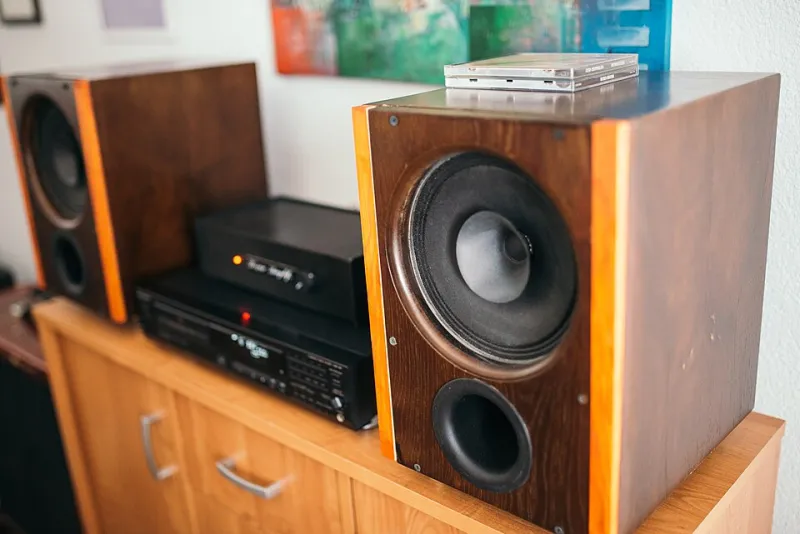
Photo: Shixart1985, CC BY 2.0, via Wikimedia Commons
There is a particular disappointment familiar to anyone who loves the violin: you attend a concert, the sound of the instrument filling the hall with warmth and detail, and then you purchase the recording — only to find that at home, something has gone missing. The tone is flatter. The nuances of bow control seem muted. The whole experience feels like reading a letter written in someone else's handwriting.
The culprit is rarely the recording itself. More often, it is the chain of compromises between the studio and your ears.
The Violin Is a Difficult Guest
From an engineering standpoint, the solo violin occupies one of the most demanding stretches of the audible spectrum. Its fundamentals sit roughly between 200 and 1,300 hertz, but the harmonics — the overtones that give a Stradivari or a Guarneri its identifiable voice — extend well above 10 kilohertz. Those upper harmonics are precisely where inexpensive playback equipment tends to give up.
"A phone speaker physically cannot reproduce what makes a great violin sound like a great violin," explains one mastering engineer we spoke with, who asked to remain anonymous. "You're hearing a sketch of the instrument. The body, the air, the resonance of the hall — that information simply isn't in the signal the speaker can move."
Compounding the problem is the listening environment itself. A concert hall is designed, down to the placement of every panel and reflector, to present the violin favorably. Your living room was designed around a television.
Four Rooms, Four Different Violinists
Consider how the same recording transforms across common American listening scenarios:
- Earbuds on a commute. Surprisingly intimate. Because the transducers sit inches from the eardrum, you hear fingering noise, string creaks, and breath — details lost in larger rooms. What you lose is space and the sense of an instrument existing in air.
- The car stereo. Road noise masks the quietest pianissimos, but a well-tuned car system with a subwoofer can lend the violin's lower register a satisfying warmth. Many engineers privately admit that modern car audio outperforms most living-room setups under a certain price point.
- The laptop or phone speaker. The harshest compromise. Dynamic range collapses; the difference between a delicate pianissimo and a full-voiced forte nearly disappears — and with it, much of the drama.
- A considered hi-fi system. Here the recording can finally breathe, provided the room cooperates.
What Listeners Lose — and What They Sometimes Gain
The losses are real: hall ambience, dynamic contrast, the three-dimensional image of an instrument placed in space. But engineers are quick to note an unexpected gain. At home, you control the volume. At a live concert, fortissimos arrive whether you're ready or not; at home, you can lean into a pianissimo at midnight, repeat a single eight-bar phrase a dozen times, and study a performance with an intimacy no concert hall permits.
For students and serious listeners, that repeatable scrutiny is its own kind of privilege.
Building a Room That Honors the Instrument
Recording engineers offer a remarkably consistent set of recommendations for classical listeners:
First, position beats price. Pull your speakers away from the wall — at least a foot or two — and form an equilateral triangle with your listening chair. This single free adjustment does more for violin reproduction than a hundred-dollar cable ever will.
Second, tame the reflections. Hard parallel surfaces — bare walls, glass coffee tables, hardwood floors — create the fluttering echoes that harden a violin's upper harmonics. A rug, curtains, and a bookshelf break up these reflections cheaply and attractively.
Third, listen at moderate levels. The violin was designed to be heard in rooms of people, not to assault. Playback at conversational volume reveals more tonal truth than maximum loudness.
Fourth, choose recordings engineered for the format. Many classic violin recordings were mixed for stereo speakers; some newer releases are optimized for headphones. Knowing which you're playing matters.
Finally, trust a familiar reference. Engineers keep one well-known recording they know inside and out — a sonic yardstick. For violin lovers, a beloved recording of a favorite concerto serves the same purpose: when the system changes, the reference tells you what you've gained and what you've lost.
The Recording as Second Performance
There is a school of thought, common among performers, that a recording is not a document of a performance but a performance in its own right — constructed take by take, with an intimacy no hall can offer. Heard through a thoughtfully arranged living room, that second performance comes fully alive: the whisper of the bow at the frog, the slight hesitation before a phrase, the resonance of a hall captured decades ago.
The concert will always be the violin's natural habitat. But with a little attention to the room you listen in, the living room can become something rarer — a place where a great performance returns, on demand, exactly as you wish to hear it.