Quiet Hands, Rosin Dust, and Lucky Silence: The Small Ceremonies That Carry a Violinist Onstage
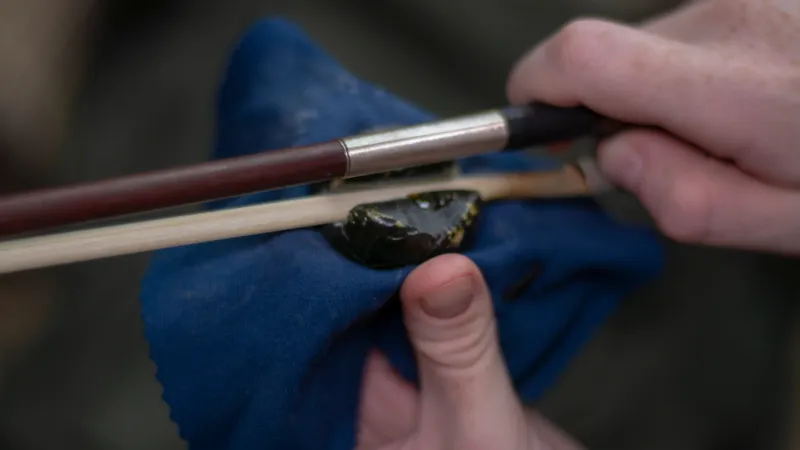
Photo: violinist applying rosin to bow backstage before concert, via www.sharmusic.com
Ask a violinist what happens in the final minutes before a concert, and you will usually get the same polite answer: a little warming up, perhaps some scales. Press a little further, and the real answer emerges. There is a rosin that must be the same brand used since conservatory. There is a jacket buttoned in a particular order. There is a moment — sometimes a full minute — of complete silence before walking out.
These habits are rarely printed in program notes, but in the corridors and green rooms of American concert halls from Boston to San Francisco, they are everywhere. And far from being mere quirks, they offer a revealing window into how performers manage the pressure of live music.
Why Ritual Takes Root
Performance anxiety is not a character flaw; it is a physiological fact. Racing pulse, damp palms, a mind that suddenly cannot recall the opening of a concerto played a hundred times — every working musician knows these sensations. Ritual is one of the oldest and most effective responses to them.
A repeated sequence of small, controllable actions gives the nervous system something familiar to hold onto. When the hall is unpredictable, the rosin is not. When the acoustics of a new venue are unknown, the order in which a violinist tightens the bow remains exactly as it was in the practice room. Psychologists who study performance describe this as creating a portable sense of control — a small, self-contained world the musician carries from city to city.
The stakes for a soloist are considerable. One evening, one take, no edits. A ritual, whatever its content, is a way of telling the body: we have done this before, and we will do it again.
The Rosin Question
No substance in a violinist's kit inspires more quiet loyalty than rosin. Players will defend a particular cake with the conviction of someone defending a family recipe. Some insist on a dark, sticky formula for the rich sound it produces in a warm hall; others swear by a lighter blend that keeps the bow arm clean during long orchestral programs.
One section violinist with a major American orchestra described replacing a cracked cake of rosin after fifteen years and feeling, in her words, "like I was playing with a stranger's bow." The replacement was chemically identical. It did not matter. The ritual was broken, and it took weeks before her bow arm felt trustworthy again.
Is there a rational basis for such devotion? Partly. Rosin genuinely varies in grip and dust, and players calibrate their equipment with extraordinary sensitivity. But much of the loyalty is about continuity — the comfort of knowing that one variable, at least, has not changed.
Silence, Scales, and Superstition
Beyond rosin, the rituals multiply. Some soloists practice complete silence in the final ten minutes before walking onstage — no conversation, no last-minute fingerings, just stillness. Others do the opposite, chatting easily with stagehands to keep the adrenaline from pooling.
Common threads appear again and again:
- A fixed warm-up sequence, often the same open strings, scales, and excerpt played in the same order, every time.
- A physical anchor — a handkerchief, a particular shirt, a piece of jewelry touched before entering the stage.
- A deliberate breath at the wings, sometimes paired with a mental run-through of the first eight bars.
- A refusal to look at the audience before the first note, preserving a private mental space.
A veteran concertmaster once admitted to knocking twice on the door of the green room before every performance — a habit begun as a joke in his youth and never abandoned. "At this point," he said, "I'm not sure I could play without it. And I've stopped asking whether that's a problem."
What Students Should Take From It
For young violinists, the lesson is not to copy a famous player's superstitions but to build a routine of their own — deliberately, and early. A good pre-performance routine has three qualities.
First, it is repeatable anywhere. A ritual that depends on a specific practice room or a specific brand of water will fail on tour. The best routines travel light: a breathing pattern, a warm-up sequence, a mental rehearsal of the opening phrase.
Second, it is calibrating, not comforting. A ritual should tune the body toward performance — raising energy if the player tends to feel flat, lowering it if nerves run hot. The goal is readiness, not avoidance.
Third, it is flexible under pressure. Every performer eventually encounters the broken ritual: the forgotten rosin, the delayed flight, the warm-up cut short. Students should rehearse recovering from a disrupted routine, because the ability to perform without the ceremony is, ultimately, the deeper security the ceremony is meant to provide.
The Common Thread
Whether it is rosin applied in a precise number of strokes or a minute of silence at the stage door, these habits share one purpose: they convert anxiety into action. They give the performer a sequence of things to do at the exact moment when there is nothing left to do but wait.
Audiences rarely see any of it. What they hear is a violinist walking out with apparent ease, lifting the instrument, and beginning. But that ease is often manufactured — carefully, privately, one small ceremony at a time. The music on the page is the same for everyone. The road to the first note is not, and it is worth remembering that some of the most important playing of an evening happens before a single sound is made.