Where the Violin Blooms: A Violinist's Guide to Choosing Your Seat in the American Concert Hall
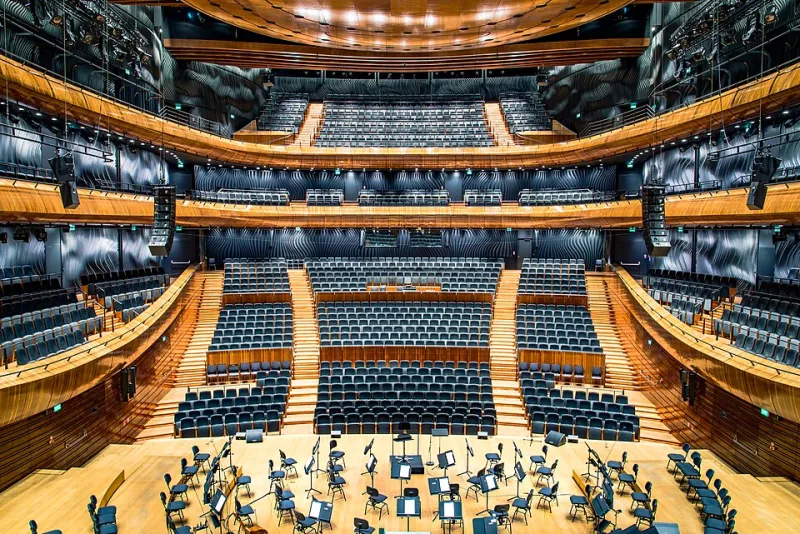
Photo: Radek Grzybowski rgrzybowski, CC0, via Wikimedia Commons
Audiences often assume the best seat at a violin concert is the one closest to the stage. From the performer's side of the footlights, the truth is more complicated — and far more interesting. The sound of a violin does not simply travel in a straight line from the strings to your ear. It is built in the room, reflected off walls and ceilings, and assembled over distance. Where you sit determines which version of the instrument you meet.
Why Distance Can Be a Gift
A violin projected into a hall needs roughly ten to fifteen rows of seats to fully form its voice. In the first few rows, you hear the instrument at close range: the bow on the string, the breath of the player, the mechanical detail of every shift. It is intimate, sometimes thrillingly so. But the tone has not yet bloomed. The overtones that give a great violin its warmth and carrying power are still developing in the air above the audience.
Move back to the middle of the hall — roughly the center of the orchestra section, or the first few rows of the balcony — and the picture completes itself. The direct sound and the reflected sound arrive together, blended and balanced. This is why experienced listeners, and many musicians buying their own tickets, gravitate toward the rear of the orchestra or the front of the mezzanine. In halls like Boston's Symphony Hall or San Francisco's Davies Symphony Hall, that middle distance is where a violin sings most completely.
Know Your Hall's Architecture
American concert halls generally fall into three architectural families, and each treats a violin differently.
The shoebox. Rectangular, high-ceilinged, with parallel side walls that return sound to the stage and the audience in layered reflections. Boston's Symphony Hall is the classic American example. In a shoebox, almost every seat is well served, but the rear orchestra and balcony front offer the richest blend. Side seats near the walls can be surprisingly vivid, since the lateral reflections are strongest there.
The fan. Wider than it is deep, spreading seats in an arc around the stage. Fans feel democratic and sightlines are excellent, but width works against the violin's directional high frequencies. Listeners far to the sides hear a thinner, more diffuse tone. In a fan-shaped hall, prioritize depth over centrality — sit farther back on the centerline rather than close and wide.
The vineyard or terraced amphitheater. Audiences surround the stage in terraced blocks, as in many newer American halls. These rooms can be wonderfully immediate, but the seats behind and beside the orchestra hear an unbalanced picture — powerful for a symphony, less flattering for solo violin. For a violin concerto, choose terrace seating facing the soloist, ideally elevated, where the sound has room to open over the orchestra.
The Soloist's Perspective
Performers notice where audiences sit more than you might think. A hall that is full at the back sounds full to us on stage; the reflected energy of an engaged room feeds directly into how we shape a phrase. Certain seats become known to traveling soloists. The balcony front of a well-built hall is often described among musicians as the honest seat — the place where nothing is hidden and nothing is exaggerated. If you want to compare interpretations between two artists, sit there.
Conversely, be wary of the extreme front corners beside the stage. Sound from the soloist's instrument projects outward and overhead; a seat at the far side of the first row can leave you listening to a performance from behind its left shoulder.
Practical Advice for Students on a Budget
Students need not sacrifice sound for price. In fact, the best acoustics are frequently among the cheapest tickets.
- Buy the rear orchestra or balcony center first. These are usually the least expensive seats in the house and often the best-sounding.
- Ask the box office about partial-view or obstructed seats. A column edge or a slightly angled view rarely affects the sound — and the discount can be substantial.
- Look for student rush programs. Most American orchestras offer same-day discounts, and many now have dedicated student sections. Arrive early; the best acoustic bargains go first.
- Attend open rehearsals. Several orchestras across the country sell inexpensive rehearsal tickets. The playing is often at full intensity, and you can hear the same hall at a fraction of the cost.
- Move at intermission. Ushers will rarely object if an empty seat in a better acoustic zone is open. This is not guaranteed at a sold-out concert, but at a lightly attended one, the second half can be a free upgrade.
A Final Note
Choosing a seat is a form of listening. Think of it the way you would think of a recording: the microphone position changes everything. A violin heard from row Z is not a diluted version of the violin in row A — it is the finished version, the one the player is actually shaping for the room. Sit far enough back to let the instrument finish its sentence, and the hall will do the rest.