Slow Is the New Fast: Inside the Practice Philosophy That Shapes a Masterclass
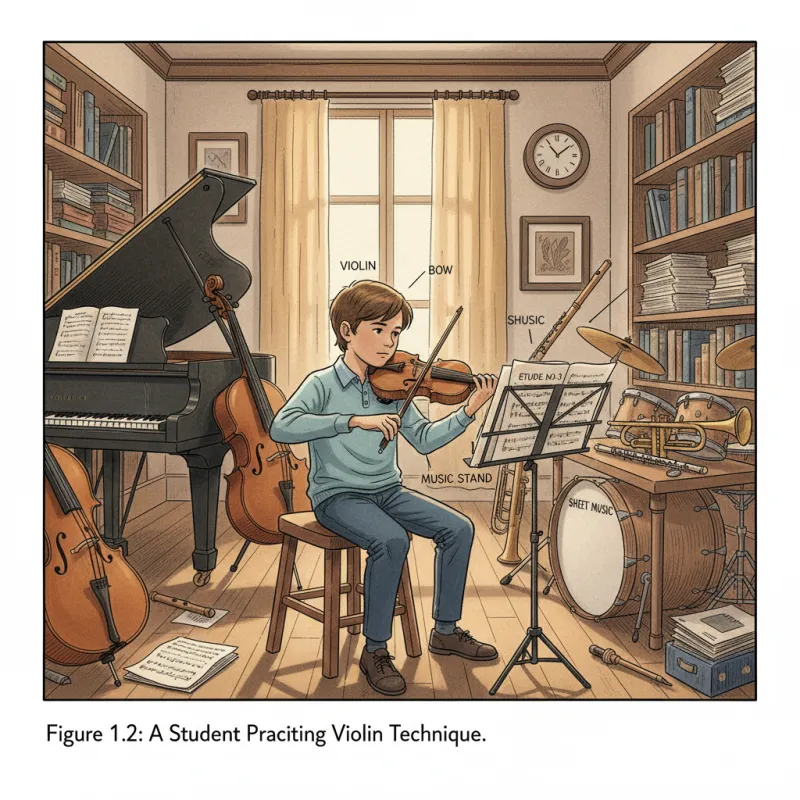
Photo: violin student practicing alone in music school practice room, via download-pa-s3.thethinkacademy.com
Walk into any conservatory practice corridor in America — Juilliard, the Colburn School, the Jacobs School of Music — and you will hear the same thing: scales at speed, repertoire at speed, everything at speed. It is the sound of ambition. It is also, according to a teaching philosophy refined over decades of masterclass work, frequently the sound of wasted time.
The instruction that Shlomo Mintz has offered to young violinists across Europe, Asia, and the United States rests on a deceptively simple premise: the violin rewards patience long before it rewards speed. This article gathers the recurring themes of that instruction into a practical framework — one that a high school senior preparing for All-State auditions in Texas can use as readily as an adult amateur rehearsing in a Brooklyn apartment.
The Metronome as a Mirror, Not a Taskmaster
The first habit worth stealing is an attitude change toward the metronome. In many American studios, the device functions as a finish line: set a tempo, fail, repeat until it sticks. The masterclass tradition treats it differently — as a diagnostic instrument. Playing a difficult passage at half speed does not merely make it easier; it exposes every hesitation in the left hand, every inconsistency in the bow's contact point, every place where the fingers are guessing rather than knowing.
The practical takeaway is arithmetic. If a passage cannot be played cleanly at sixty beats per minute, it cannot honestly be played at one hundred and twenty. Students who internalize this stop treating slow practice as a humiliation and start treating it as the fastest route available.
Bow Arm First: The Five-Minute Ritual
A second recurring theme concerns the bow arm, which receives disproportionate attention in masterclass settings precisely because it is where tone is born. The exercises are unglamorous: long, sustained whole-bow strokes played on open strings, with the player listening not for volume but for evenness — the moment the bow crosses from frog to tip without the sound changing character.
Consider building a five-minute ritual at the start of each session:
- Two minutes of open-string whole bows, focusing on a straight path and constant weight.
- One minute of string crossings, aiming for silence in the transitions between strings.
- One minute of spiccato at a modest tempo, letting the bow bounce naturally rather than forcing it.
- One minute of crescendo and diminuendo on a single note, learning where the arm's weight lives.
None of this sounds like music. All of it shows up in the music. Listeners at a recital cannot name a clean bow change, but they hear one — or rather, they never have to notice it.
Practicing the Performance, Not Just the Piece
The third theme is psychological, and it may matter most to American students raised on high-stakes auditions. Masterclasses repeatedly return to a distinction between practicing a piece and practicing a performance. The former corrects errors in private. The latter trains the nervous system to function when adrenaline arrives.
The method is straightforward and costs nothing. In the final week before an audition or recital, run the complete program — no stopping, no restarting, no fixing. Record it on a phone. Listen once, take notes, and put the recording away. The goal is not perfection; it is familiarity with the feeling of being unable to stop. Students who rehearse this discomfort discover that the concert hall holds fewer surprises than the practice room feared.
A related habit: perform for people, often and casually. A run-through for family members in the living room, a visit to a retirement community, a church recital series — these low-stakes appearances build the muscle that no amount of solitary drilling develops.
What the Notebook Ultimately Teaches
Perhaps the most valuable lesson from decades of masterclass instruction is not any single exercise but a posture toward the instrument. Progress on the violin is not linear; it is architectural. Some weeks build foundations that will not be visible for a year. Students who expect weekly proof of improvement quit; students who accept the timeline stay.
For the American learner — whether a conservatory freshman in Rochester or a returning player in Denver — the invitation is the same. Slow down. Listen more than you play. Practice being nervous. The violin has survived three centuries by rewarding exactly this kind of patience, and it has not changed its terms.