Never in the Overhead Bin: How Soloists Outsmart the Airlines to Keep a Stradivarius Safe at 30,000 Feet
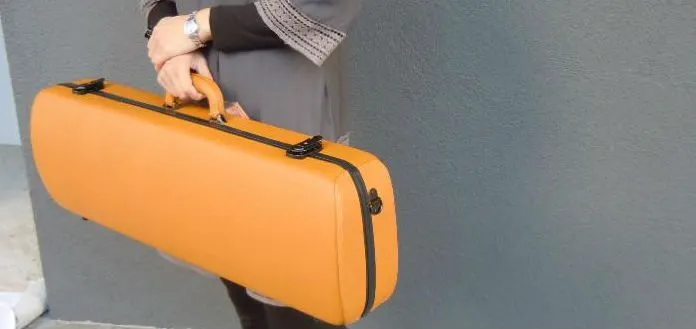
Photo: violinist carrying violin case at airport gate, via theviolinchannel.com
The Gate Is Where the Trouble Begins
The concert went beautifully. The reviews were glowing. And yet, for the violinist on that United flight from Chicago to Denver, the evening's real drama had nothing to do with the Tchaikovsky concerto. It happened at Gate B14, when a gate agent looked at a violin case and asked the question every traveling soloist dreads: "Will that fit in the overhead bin?"
For most passengers, the answer is a simple yes or no. For a musician carrying an instrument worth more than the airplane's galley, the stakes are considerably higher. A cello cannot fly in an overhead bin under any circumstances. A violin usually can — but "usually" is not a word that comforts someone entrusted with a three-century-old Cremonese treasure.
What the Rules Actually Say
Since 2015, US air travelers have been protected by the FAA Modernization and Reform Act's provisions on musical instruments, often called the "instruments act." In plain terms: airlines operating aircraft with a minimum bin size must allow a violinist to stow a small instrument in the cabin, provided it fits in approved overhead or under-seat space. It cannot be bumped by later passengers, and it cannot be forced into the hold.
The law, however, is only as strong as the employee reading it. Veteran players describe a patchwork of experiences across American carriers. One airline's crew might greet a violin case with a knowing nod; another's might demand it be gate-checked on a full regional jet with undersized bins. The savvy soloist prepares for both.
Buying a Seat for a Cello — and Sometimes for Less
Cellists have long understood the arithmetic of air travel: if the instrument needs a cabin seat, the musician buys two tickets. Airlines permit a cello to occupy a purchased seat, strapped in like a very quiet, very valuable companion. The instrument boards first, gets the window, and never sees a baggage handler.
Violinists rarely go that far. But some do purchase extra-legroom rows purely to guarantee bin space directly above their own seat, removing any chance of a flight attendant redirecting the case to the rear of the aircraft — or to the cargo hold on a crowded Embraer.
The Briefcase That Flies With the Fiddle
Ask a touring soloist what else travels in the cabin, and the answer is not just music. It is paperwork.
- A current appraisal letter, often renewed every few years, stating the instrument's market value
- High-resolution photographs documenting every crack, repair, and varnish scar — proof of condition in case of a claim
- A certificate of insurance naming the airline coverage terms
- For older instruments: provenance documents, and increasingly, CITES documentation for bows containing restricted materials
Luthiers advise clients to treat this dossier like a passport. A violin that travels internationally without its paperwork can be detained at customs; a violin that travels domestically without an appraisal may be uninsurable at the moment it matters most.
Near-Disasters and the Lessons They Taught
Players swap these stories the way pilots do. The colleague whose case was pulled for a random gate-check and returned with a detached shoulder rest and a hairline fracture near the f-hole. The bin that was overstuffed by a late-boarding passenger's suitcase, forcing a violin into the aisle for want of room. The regional jet swapped at the last minute, leaving bins too small for anything larger than a coat.
Each incident has produced a workaround. Hard-shell carbon-fiber cases, once viewed with suspicion by traditionalists, have become the touring standard precisely because they shrug off the indignities of modern air travel. Some soloists wrap the instrument in silk inside the case to buffer humidity shocks. Nearly all of them board in the first group, whatever it takes — elite status, an early check-in, or simply standing first in line.
When the Violin Simply Cannot Fly
There is a final category of caution: the soloist who refuses to fly with the instrument at all. For certain irreplaceable instruments, the calculus changes. A handful of players arrange ground transport between nearby tour cities, or rely on a trusted technician to courier the violin by climate-controlled car. Others maintain relationships with luthiers in major American cities who can supply a fine loaner instrument if a flight becomes impossible.
It is an imperfect solution, and no one pretends otherwise. A violinist's sound lives in their own instrument — in its response, its resistance, the way it speaks under the bow. Substitutes are exactly that.
The Quiet Ritual at the Jet Bridge
Watch a seasoned soloist board an American flight, and you will notice a small, unvarying ceremony. The violin case is lifted — never dragged — carried down the jet bridge by hand, placed in the bin with the handle forward and nothing resting against the latches. A coat or briefcase is sometimes wedged gently beside it to prevent sliding.
No announcement is made. No one applauds. And yet every note the audience hears that night depends on this invisible logistics chain: a federal statute, a well-drilled routine, a folder of appraisals, and a case that has crossed the country more times than most passengers ever will.
The encore may bring the audience to its feet. But the true mark of a touring professional is quieter: a violin that has flown a hundred flights and landed, every single time, in the cabin — where it belongs.