Before the Lights Dim: Five Concertos Every American Listener Should Experience in the Hall
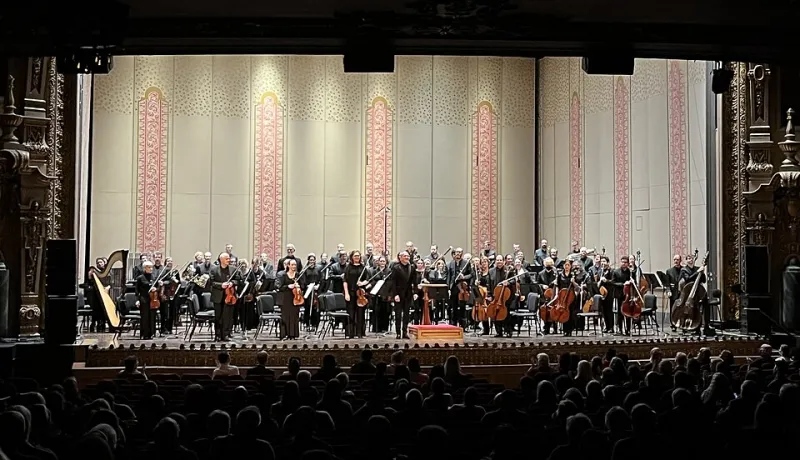
Photo: Cbusram, CC BY 4.0, via Wikimedia Commons
Streaming has been a gift to classical music, but it has also quietly reshaped how Americans hear the great concertos. Compressed through earbuds, a violin concerto becomes a foreground experience: melody, soloist, drama. Heard live, from the twelfth row of a hall like Boston's Symphony Hall or San Francisco's Davies, it becomes something closer to architecture — a structure you stand inside of, with the soloist's sound wrapping around you in ways no recording can replicate.
Not every concerto gains equally from this transformation. These five, drawn from the core of the repertoire that artists like Shlomo Mintz have carried through the world's halls for decades, gain the most.
1. Brahms — Violin Concerto in D major, Op. 77
Brahms's only violin concerto is often described as a symphony with an obstinate soloist, and live, that description lands with full force. The orchestral writing is so substantial that the violin must carve its way through — and in a real hall, you can feel that struggle physically.
What to listen for: the long-breathed second theme of the first movement, and above all the oboe melody that opens the slow movement, answered by the soloist as if in conversation. Which movement rewards repeat hearings: the finale, whose Hungarian-inflected rondo reveals its wit only after the weight of the first two movements has registered. How to prepare: listen once at home for the overall shape, then resist the urge to over-study. Brahms rewards surrender more than analysis.
2. Sibelius — Violin Concerto in D minor, Op. 47
No concerto sounds smaller on a recording than Sibelius's — and none sounds larger in the hall. The opening violin line, emerging over shivering muted strings, seems to rise out of the concert hall itself, a northern dawn rendered in sound.
What to listen for: the soloist's first entrance, a long melodic arc that must sustain itself without accompaniment; and the finale, a relentless dance that critics famously likened to "polonaises for polar bears." Which movement rewards repeat hearings: the Adagio, whose climactic ascent is the emotional summit of the entire work. How to prepare: arrive early. The hush before this concerto is part of the piece.
3. Tchaikovsky — Violin Concerto in D major, Op. 35
The most popular violin concerto in America's orchestral seasons remains popular for a reason: it is a showcase that never stops singing. Live, the first movement's cadenza — placed, untraditionally, near the opening — lands with an immediacy that recordings flatten.
What to listen for: the Canzonetta, a slow movement of extraordinary restraint that sets up one of the great transitions in the repertoire; and the finale's folk-dance momentum, which in a good hall becomes almost communal. Which movement rewards repeat hearings: the first, where the balance between lyricism and virtuosity is endlessly debated by soloists. How to prepare: none required. But hearing it live after knowing it from recordings is a genuine revelation.
4. Mendelssohn — Violin Concerto in E minor, Op. 64
Mendelssohn solved problems that tormented composers for a century: his concerto begins with the soloist immediately, connects all three movements without pause, and gives the orchestra genuine partnership. In performance, its seamlessness is far more audible than on record — you can watch the threads being tied.
What to listen for: the bassoon's soft note beneath the first movement's final cadence, the hinge into the slow movement; and the fleet final pages, among the most joyous in the repertoire. Which movement rewards repeat hearings: the Andante, whose middle section darkens unexpectedly, deepening everything around it. How to prepare: it is the perfect first live concerto — ideal for bringing a friend new to classical music.
5. Beethoven — Violin Concerto in D major, Op. 61
Beethoven's concerto begins with four soft taps on the timpani — a gesture so strange that early audiences were baffled. Live, in a resonant hall, those taps seem to establish the pulse of the entire evening. What follows is the most serene and the most demanding of the great concertos: nearly fifty minutes of sustained concentration.
What to listen for: the long orchestral exposition, which builds the world the soloist will inhabit; and the final rondo's gentle humor, so often rushed on recordings. Which movement rewards repeat hearings: the Larghetto, a set of variations on a theme of almost impossible stillness. How to prepare: get a full night's rest. This is the marathon of the repertoire, and it asks something of the listener, too.
Why the Hall Matters
A recording is a document; a concert is an event. The great violin concertos were written for rooms, for air, for the physical presence of a soloist standing alone before an orchestra of ninety. For American concertgoers accustomed to encountering this music through headphones, hearing even one of these five works live — in the company of several hundred strangers holding the same silence — is the fastest way to understand why the concerto has remained the crown of the repertoire for two centuries. The next season's schedules are published each spring. Choose one. Then choose a seat near the front.