Carrying the Whole Score: Inside the Soloist's Memory and What Happens When It Slips
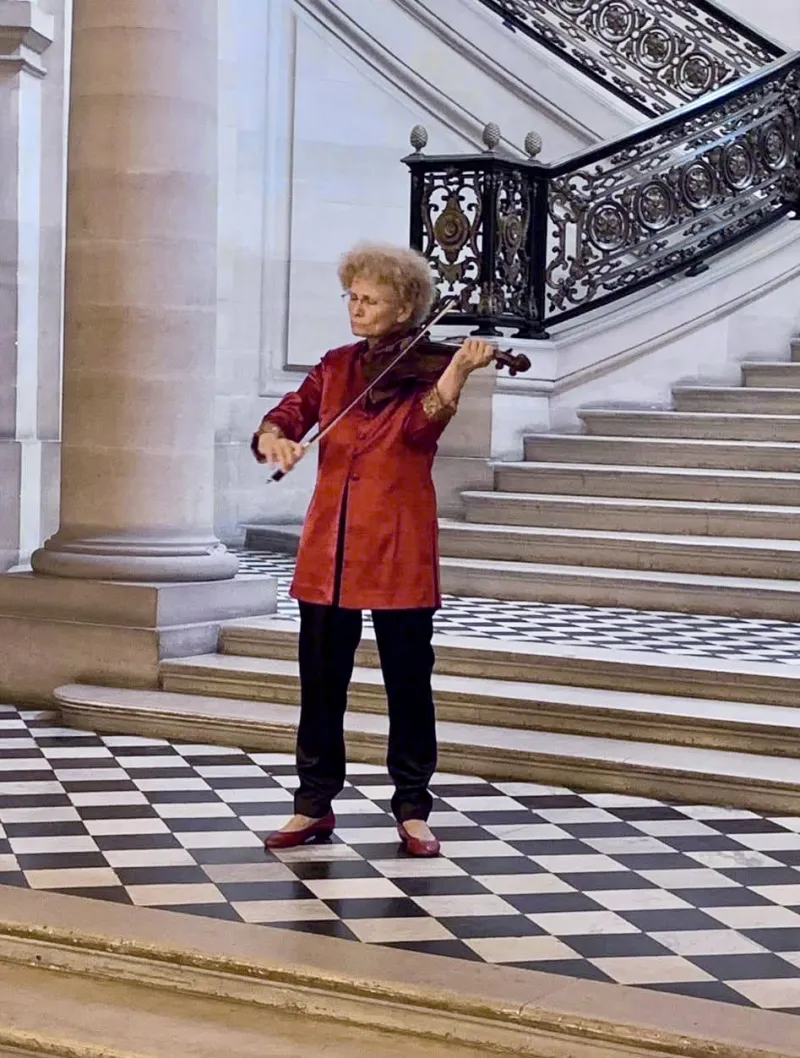
Photo: Slavacheri, CC0, via Wikimedia Commons
There is a moment, just before the downbeat, when the audience settles and the hall goes quiet. The soloist steps forward. There is no stand. No score. Only the accumulated weight of every note, every interval, every page — held somewhere behind the eyes. For concertgoers, this has become so routine that we rarely stop to consider how extraordinary it is: a human being about to reproduce, from memory alone, tens of thousands of notes in exact sequence, with expressive intention attached to each one.
Not One Memory, But Four
The first misconception about musical memory is that it lives in the fingers. Teachers hear it constantly from students: I just play it until my hands know it. Finger memory — what psychologists call motor or procedural memory — is real, and it matters enormously. But any soloist will tell you it is the least trustworthy of the memory systems they rely on. It is also the most fragile. It dissolves under adrenaline, under an unfamiliar piano's touch, under a hall's strange acoustics that make everything sound slightly wrong.
Professional memorization is layered. Beneath the motor memory lies analytical memory — an understanding of the piece as architecture. Where is the modulation? Which bar begins the development? What harmonic sequence carries the second theme back to the tonic? A violinist who has truly internalized a concerto can describe its structure the way an architect describes a building: this is the foundation, this is the load-bearing wall, this is where the staircase turns.
Above that sits aural memory — the ability to hear the music internally, away from the instrument. Many artists test themselves on airplanes, running a concerto silently in their heads, note by note, checking for passages that blur. And alongside all of it works visual memory: some musicians see the page in their mind's eye, others track their left hand's position on the fingerboard, others recall the geography of the score's shapes.
The security of a performance comes from these systems reinforcing one another. If one stumbles, the others catch it.
Building the Palace
The classical tradition of memorization owes more than it admits to the ancient mnemonic technique of the memory palace — the method of loci, in which information is stored in imagined locations along a familiar route. Violinists build something similar, though their palace is made of harmony and gesture rather than rooms and corridors.
A typical construction process looks something like this:
- Structural mapping first. Before a single bar is memorized, the performer writes out or annotates the piece's formal skeleton — key centers, themes, transitions, climaxes. The map becomes the palace's floor plan.
- Chunking. Nobody memorizes forty minutes at once. The work happens in small cells — four bars, eight bars — each one analyzed, hummed, played, and then connected to its neighbors from both ends.
- Backwards practice. Memorizing the ending first is a time-honored safeguard. The final pages of a concerto, performed last and remembered least confidently, get the most preparation.
- Slow, deliberate recall. The piece is played at half tempo from memory, then in fragments, then transposed up a half step — a brutal test that exposes whether the player knows the music or merely the choreography.
- Mental rehearsal. Away from the violin, the performer 'plays' the entire work in the mind, following the imagined sound. If the inner hearing fades or hesitates, that passage returns to the practice room.
The whole process can take months. A Sibelius concerto memorized properly is not learned in a week; it is inhabited.
When the Palace Trembles
Audiences almost never see memory fail, and that is itself a testament to the system. But performers carry the stories. Every seasoned soloist knows of a colleague — or has been the colleague — who lost the thread in a passage played flawlessly a thousand times before.
What is striking is how recovery actually works. Because the analytical memory holds the structure, a lapse in the fingers does not necessarily end the performance. The musician knows where they are in the piece even if they cannot recall the next note — and in the worst case, they can simplify, improvise a bridge over the harmony, and rejoin the score a few bars later. Listeners in the hall often never know. It is one of the performing world's quietest skills: the ability to fail invisibly.
This is also why memory lapses, when they do become public, are treated in the profession less as scandals than as accidents — like a skater's fall. The response among artists is rarely mockery. It is recognition. Everyone who walks on stage without a stand knows the risk they accepted.
What the Amateur Can Borrow
Students and dedicated amateurs sometimes conclude that memorization is a professional luxury, irrelevant to someone playing community orchestra or studio recitals. That is a mistake. The techniques scale down beautifully, and they improve musicianship even for players who never perform without a stand:
- Name the harmony. Before memorizing a passage, label its chords. Understanding why a melody moves where it does gives the memory something to hold besides finger patterns.
- Practice away from the instrument. Ten minutes of mental practice on the commute — hearing the piece, tracing the phrases — is worth an hour of distracted repetition.
- Test from the end. Learn the last phrase first, then work backward. Openings are naturally over-rehearsed; endings are where memory quietly fails.
- Perform in low stakes. Play one memorized page for a friend, then two. Memory under pressure is a separate skill from memory in the practice room, and it only develops with exposure.
- Describe the piece in words. If you can narrate a movement's structure — what happens, where it turns, how it resolves — you own it in a way finger memory alone never provides.
The Deeper Reward
Ask soloists why they continue to perform from memory in an era when the score could sit on a tablet, and the answers return, eventually, to the same idea: freedom. Without the page, the eyes are free to close, to communicate, to listen inward. The performance becomes continuous with the player rather than mediated by notation.
That is the real purpose of the palace. It is not a stunt, and it is not nostalgia. It is the removal of every barrier between the music as imagined and the music as heard — so that what reaches the back row of a concert hall is as close as possible to what the composer heard first.