Between the Movements: A Concertgoer’s Guide to Applause and the Art of Waiting
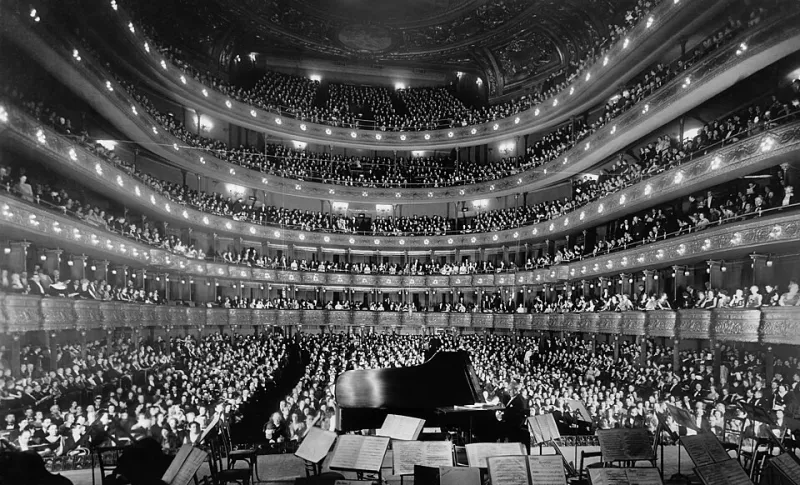
Photo: Unknown or not provided Retouched by Mmxx, Public domain, via Wikimedia Commons
The Moment After the First Movement
The final chord of a first movement fades. The conductor’s baton rests. For a second or two, the hall becomes a held breath. Then someone reaches for a program, a cough escapes from the balcony, and a listener in the fifth row begins to bring their hands together — then stops, uncertain. The moment is not about etiquette for its own sake. It is about what happens when a large room full of people tries to decide, together, whether the music has ended.
Applause is one of the oldest forms of audience participation in Western concert life, yet it is also one of the most frequently misunderstood. For newcomers to the concert hall, the space between movements can feel like a trap. For seasoned listeners, it can be a mark of concentration. For performers, it is information: a gauge of attention, tension, and enthusiasm. The silence is not empty. It carries meaning.
A Short History of Clapping
Applause conventions have not always been as restrained as they are today. In the eighteenth and nineteenth centuries, audiences often applauded individual movements, demanded encores, and treated a concert as a social event as much as an artistic one. Composers sometimes expected applause between sections of a large work. Over time, and especially in the twentieth century, the concert hall developed a more solemn code. Recordings, radio broadcasts, and the rise of the modern recital helped cement the idea that a multi-movement work should be heard as an uninterrupted whole.
The change was never total. Opera audiences still applaud after arias. Jazz audiences applaud solos. American symphony audiences are warmer and more spontaneous than the stereotype suggests. The silence between movements is therefore less a universal law than a convention — one that varies by hall, by program, and by the mood of the evening.
What the Silence Is For
The silence has a practical purpose. A concerto or sonata is not a playlist of separate pieces. It is a single argument in several chapters. The pause between movements allows the ear to adjust, the performer to reset, and the music’s architecture to remain intact. Applause can break that thread, especially in a work whose movements are meant to flow without a break.
There is also the matter of concentration. A soloist may be holding a phrase in the mind, preparing for the next movement’s character, or simply breathing. The audience’s quiet is a form of cooperation. It is not a demand for solemnity. It is an invitation to stay inside the music a little longer.
How Performers Read a Room
From the stage, applause is only one signal among many. A soloist can feel the rustle of programs, the quality of the coughs, the stillness before a slow movement. In masterclasses, students are often taught to prepare not only the notes but the transitions between movements — the way the body settles, the way the eyes lift, the way the next phrase begins. The audience is part of that preparation. A hall that waits is a hall that is listening.
Performers do not generally keep score of misplaced claps. A single early burst of applause is rarely a scandal. It is more often a sign that someone was moved. The greater challenge is the opposite: an audience so worried about doing the wrong thing that it forgets to respond at all.
A Practical Guide for the Uncertain
The safest rule is simple: applaud when the work is complete. That means after the final movement of a concerto, sonata, or symphony; after the last piece on a recital program; and after an encore. It also means applauding when the soloist or conductor first walks onstage, and again when they return after the intermission. These are greetings and thanks, not judgments on the music.
Between movements, the better choice is usually to wait. If the audience around you begins to clap and you are unsure, it is not necessary to join in immediately. If you do clap early, there is no need to apologize. The music will continue.
A few practical markers can help. If the conductor’s baton is still raised, the work is not over. If the soloist’s bow is still on the string, the phrase is not finished. If the program lists several movements under one title, the pauses between them belong to the piece. When in doubt, watch the performers rather than the audience. Their body language will tell you more than any printed rule.
The American Context
American concert life has its own character. Audiences are often demonstrative, and presenters have worked hard to make the hall feel less forbidding. Some orchestras print gentle reminders in programs; others trust the audience to find its way. The goal is not to scold newcomers but to invite them into a shared ritual. A concert is not a test of manners. It is a collective act of attention.
The Space Between
Silence between movements is not a rebuke to enthusiasm. It is a way of protecting the music’s continuity, and a way of giving the audience a role beyond consumption. When the final chord dies away, applause is the audience’s way of saying thank you. Between movements, the most eloquent thing may be to wait — not because the rules demand it, but because the music has not yet finished speaking.